Tuesday, June 7, 2011

TAJIKISTAN - Into the Wild (Murghab to Khargush)

Murgab to Khargush via Zor Kul
May 23-27
Distance: 215kms
Elevation gain: 1245m
Sealed:  28kms    Dirt: 187kms
Odometer: 2858kms

I left Murghab late in the morning and was growing a little bored with sealed highway and constant km markers. I had carried a weeks' supply of food from Osh just in case I went 'wild'. i glimpsed this striking landscape through a  wide flat valley so I turned off onto the 4WD track for Jarty Gumbez. I had reliable maps and I knew there was a route through to Zor Kul (lake) and the Pamir river. The only problem was I didn't have the necesssary permit to enter the area around Zor Kul.......It was a hard but exhilirating ride through wild country.

From my campsite, the dry valley looking south to Jarty Gumbez
I camped in a dry river bed near this ancient cemetery.

The skull and horns of a Marco Polo sheep. These bleached bones lay scattered by the roadside, relics of slaughter.


Descending from Yangidawan pass 4455m, down a rough sandy and rocky road.
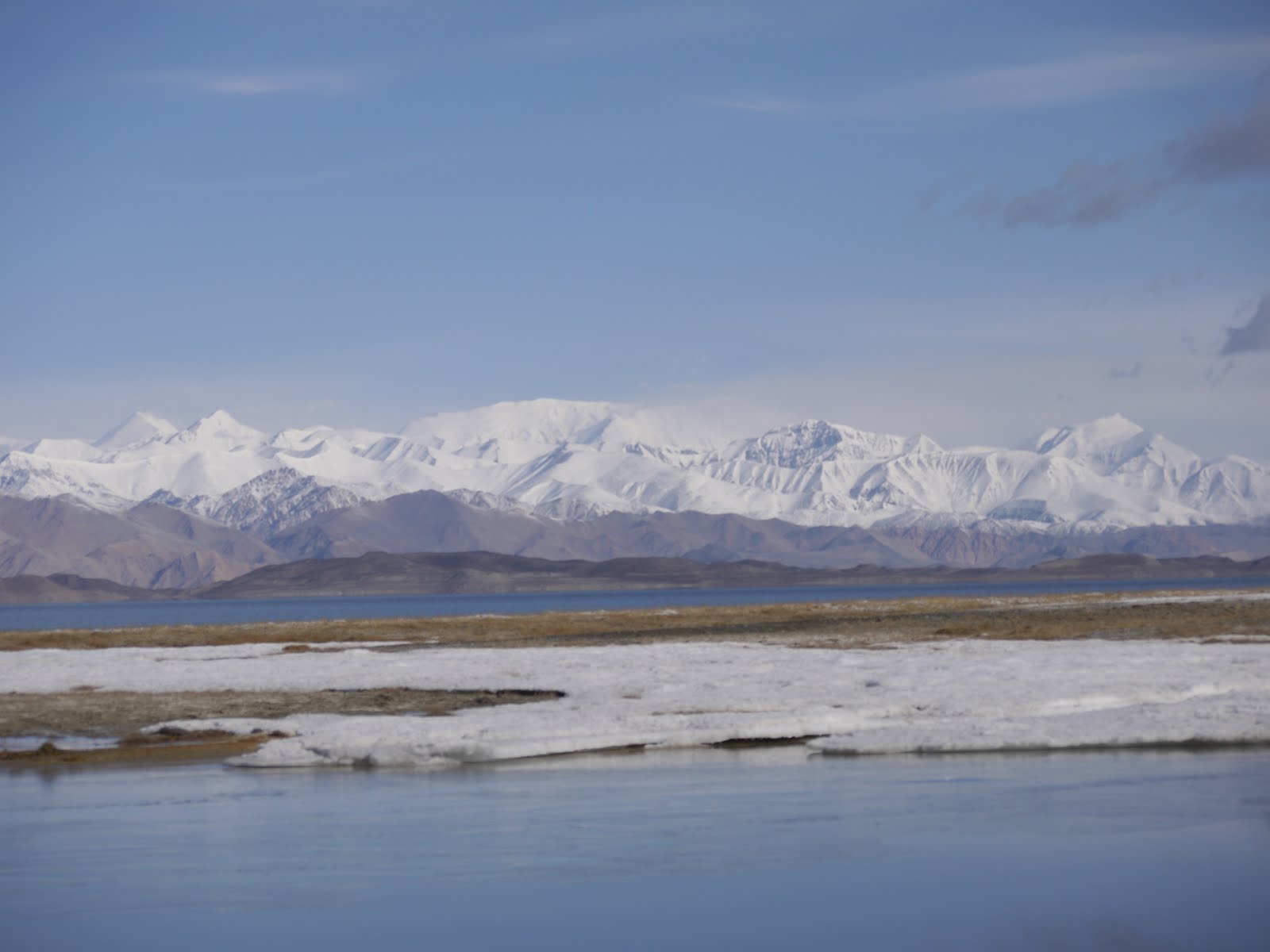
One of 2 lakes above Zor Kul. The Wakhan Mts. and Afghanistan in the background. The peak on the far right bore a striking resemblance to Cradle Mt. in Tasmania 

A  Kyrgyz yurt at Kara Jilga

Their goats in the stone corrall

In the yurt, Akunbek, plays his komuz, a 3-stringed lute. He's only 50 years old but the hard nomadic life at altitudes over 4000m has aged him.

Hiding from the bitterly cold headwinds. I found some firewood scattered around an abandoned cabin and had a warming campfire sheltered from the blasting wind.

Up at first light to beat the headwinds, I set out on the obscure 4WD track to Zor Kul. The Southern Alichur range in the distance.

Zor Kul, a 20km-long lake in the Pamiri wilderness. Originally named Lake Victoria byBritish explorers it sits at 4200m. It is the source of the Pamir river and was 50% iced over. A swirling storm is sweeping across the Wakhan Mts. and is  about to hit me violently with sleet and blasting wind.


No bridge, just a snow bridge. No wonder I hadn't seen a soul for 2 days, nor the remnants of passing tyre tracks. The iron bridge here must have been destroyed last year in the floods and no motorised traffic had been up the 4WD track for a while.
One of the peaks of the Wakhan range


The Wakhan range at dawn. Another early start for the cyclist (6am) avoiding the impending westerly headwind.

The young Pamir river flowing below the Wakhan range.

More ice sheets across the 'road'.

Border markers on both the Tajik and Afghan sides of the Pamir river. I was very worried about landmines along this route, so did a bit of boulder-hopping to fetch water. Watchtowers and sentry boxes around Zor Kul completed the bizarre 'Great Game' atmosphere.

Snow banks on the Pamir river

The road leaves the Pamir river and climbs onto a sandy plain. The grassy edges were marginally better than the thick sand, but the premature wind was detemined to slow me down.

A Bactrian camel on the Afghan side of the river.

Yaks and the Wakhan range

A yak herder who invited me to his house for lunch. He tried out my bike and rode with adroitness and perfect balance.

TAJIKISTAN - Pamir Plateau

Kyzyl Art pass to Murghab
May 19-22
Distance:196kms
Elevation gain: 1150m
Sealed:  151kms   Gravel: 45kms
Odometer: 2633m

At last, the Pamirs! A dramatic entry into Tajikistan and the Pamirs in a snowstorm, headwinds across the desert high plateau, the azure waters of Karakul lake and the highest pass on the route.

My route through the Pamirs. The dotted line is my proposed route in the Western Pamirs from Khorog to Karakul via the Bartang valley. (Click on map to enlarge)

Over the Kyzyl Art pass (Kyrgyz/Tajik border) in a snowstorm. 20km below the pass I was desperate for a campsite but all very exposed to the howling wind and little water about a parched landscape. Late in the day found a grassy bank for the tent and some dirty water from a pond.


My campsite in the morning after snow had blanketed the Pamir plateau overnight.

Footprints and tyre tracks leading from my camp back to the Pamir Highway.

Back on the M41, the Pamir Highway

Karakul lake, at 3900m with the Pamir Alay range in the background

A scene reminiscent of the Tibetan plateau - yaks, alpine grasslands, salty lake and snow-capped mountains.

I stayed at the small village Karakul, by the lake. The bush teresken is drying on the roof. Used as fuel, much of this vegetation has been exploited heavily and is now in short supply. Animal dung is also used, especially in the remoter areas.
A donkey leading the flock home.
Homestays are dotted all around the Pamirs. This is my room in a Karakul home - $10 a night with 3 meals.
Very cosy and warm - with wall-on-wall carpet.


Climbing up to Ak Baital pass at 4655m, the highest pass on the Pamir Highway


At Ak Baital pass 4655m, with the bandito mask to block the cold wind and stinging dust.


Just below the pass I met Sebastian, a German cyclist heading east. As it was late in the day we decided to camp in the same spot and share stories and information about the roads ahead.
Our campsite below Ak Baital pass

KYRGYZSTAN - Osh to Sary Tash

Osh to Kyzyl Art pass
May 15-19
Distance: 236kms
Elevation gain: 4560m
Sealed:  176kms    Dirt: 60kms
Odometer : 2440kms

The route from Osh to Sary Tash is the dotted line (click to enlarge)


Images from Osh Bazaar

Vegetable stall-holders

A goat's head - the bizarre in the bazaar

A flower and herb seed seller. Many Kyrgyz over 30 have mouths of gold.

Stone Dead - the tombstone art of Krgyzstan
The stonemason at work etching a portrait

His collection in the workshop

A tombstone of wood and stone, complete with horsehair, a nomadic tradition. Sary Tash cemetery


Osh to Sary Tash - images from the road
Family near Gulcha. I camped near their home. The father was very proud of his binoculars and fetched them just for the portrait.

Transport by donkey is common along the Osh-Sary Tash road.

Milking the mare for kumys (fermented mares' milk)

Yurts and green rolling hills


The road leading to the final pass before Sary Tash

The steep and sandy road leading up to Taldyk pass 3610m

A heavy and tired bike at rest

A smiling face in Sary Tash

Family in Sary Tash

Riding out of Sary Tash on a cold wet morning. I had no choice as my visa expired on this day (May 19).

Just below Kyzyl Art pass (4290m), the road had turned into a boggy morass.


Saturday, June 4, 2011

OSH - Kyrgyzstan's Dark Side

Ethnic violence of June 2010 - Kyrgyzstan's dark side

June 12 will mark the anniversary of the violent ethnic riots which erupted in and around Osh.
Over 400 people were killed, and up to 400,000 Uzbeks fled the cities of Osh and Jalahabad for sanctuary in Uzbekistan. Some are still languishing at the border refugee camps.

Why did this happen? It was an ugly 'ethnic-cleansing' episode in a violent history, reminiscent of The Balkans or Rwanda. A combination of ancient animosities, geo-political ethnic borders crudely drawn up by Stalin,  and desperation by an unpopular leader and his security forces and supporters in Osh. Uzbeks told me many Kyrgyz were jealous of their mercantile success in the Kyrgyz 'homeland', a fact shown clearly by the scorched iron and wood on the Uzbek businesses.

The Uzbeks made up 40% of the population in Osh, and historically were the sedentary pastoralists, tilling the soil and operating as merchants. The Kyrgyz, on the other hand,  have been essentially nomadic farmers herding their animals across Central Asia. This is the classic Cain v. Abel allegorical tale in a modern setting and although simplistic, may partly explain the deep ethnic divisions here.

Here are some photos I took as I left Osh. The entire Uzbek neighbourhood on the eastern outskirts of Osh was completely destroyed - incinerated by Molotov cocktails and torches, smashed with sledgehammers and looted by the rampaging mob.

The burnt-out shell of an Uzbek shop

Inside a courtyard of a razed Uzbek home, the family's van remains, waiting for its owners to return.

Entire neighbours were smashed, looted and then set ablaze by roaming hate-filled Kyrgyz men.

Russian contract workers rebuilding an Uzbek shopping centre

An uneasy calm exists in Osh Bazaar, with police and army on patrols. The security forces have been implicated in the violence, and the UN hold them responsible for instigating it. 
UNHCR are constructing transitional shelters to encourage the displaced Uzbek refugees to return to their homes. Most of the Uzbek neighbourhood in the eastern area of Osh remains eerily silent and empty.

Go to this link below to see the destruction and human suffering of this violent period.
http://www.boston.com/bigpicture/2010/06/ethnic_attacks_in_kyrgyzstan.html